Agricultural Drone 101
What are agricultural drones?
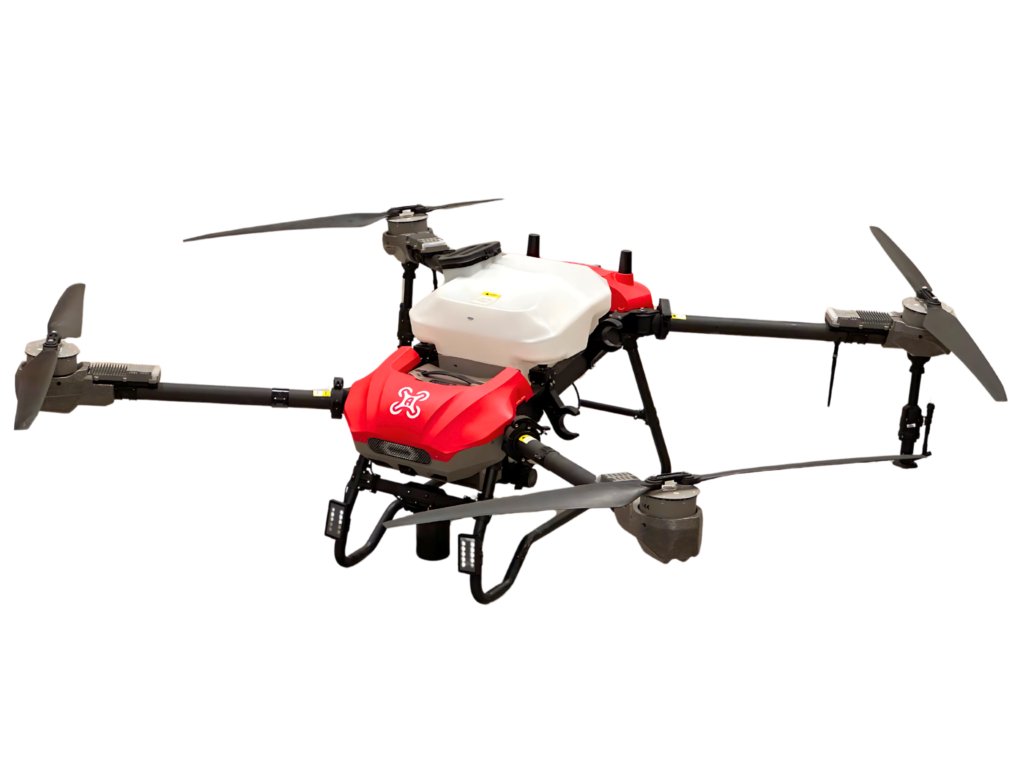
An agricultural drone is a small, unmanned aircraft designed to help farmers work more efficiently and precisely. Instead of walking fields or driving large machines across crops, farmers can fly a drone over their land to see what’s happening and take action from the air.
Think of it as a flying assistant for the farm. Agricultural drones are here to make farmers’ work easier, just like any other agricultural machinery, but smarter and tinier.
The origin of agricultural drones can be traced back to the early 2000s. Throughout their evolution, agricultural drones have become increasingly capable and intelligent, to the point where they have emerged as a practical alternative to traditional large spraying equipment.
What do the agricultural drones do?
Modern-day agricultural drones are multitaskers. Farmers could use them as flying cameras to monitor crops by quickly flying over the field and checking crop growth and plant health. As flying scarecrows, the sounds of the propellers of these low-flying drones can scare wild animals that trespass on the farm. But the most important way to use agricultural drones is to apply materials to the farmlands. As flying sprayers/broadcasters, agricultural drones can spray agrochemicals, such as pesticides or herbicides, as well as granular materials, including seeds and fertilizers.
How is the agricultural drone compared to traditional spraying methods?
Agricultural Drone vs. High Clearance Sprayer
| Aspect | Agricultural Drones | High Clearance Sprayers |
|---|---|---|
| Technology & Precision | Use GPS and sensors for highly precise, targeted spraying, reducing chemical waste and environmental runoff | Generally less precise; often spray entire areas uniformly, which can lead to uneven application |
| Application Method | Fly close to crops and apply chemicals only where needed | Ground-based spraying covers broader areas regardless of need |
| Efficiency & Labor | Can save time and labor, especially in uneven or hard-to-reach terrain | Efficient for large, flat fields but less flexible in complex landscapes |
| Ease of Use | Require technical skills and training; operators need time to learn and practice | Familiar and easy to use for most farmers |
| Payload Capacity | Limited payload; requires frequent refilling | Large liquid capacity allows longer operation per pass |
| Operating Time | Limited flight time (typically 12–15 minutes per battery), requiring frequent recharging | Can operate continuously as long as fuel and materials are available |
| Environmental Impact | Minimal soil impact since there is no ground contact | Heavy machinery causes significant soil compaction |
| Terrain Adaptability | Excellent for uneven, wet, or challenging terrain | May struggle in difficult or uneven landscapes |
| Regulatory Considerations | Subject to existing and evolving drone regulations | Well-established regulations with fewer new restrictions |
Agricultural Drone vs. Aircraft Spraying
| Aspect | Agricultural Drones | Aircraft Spraying (Planes / Helicopters) |
|---|---|---|
| Ideal Field Size | Best for small to medium-sized fields and segmented operations | Best for vast, open fields covering hundreds or thousands of acres |
| Coverage Speed | Slower coverage; less efficient for very large acreage | Extremely fast and efficient at large-scale coverage |
| Precision | Very high precision with targeted, low-altitude application | Lower precision compared to drones |
| Spray Drift | Reduced drift due to low flight altitude and controlled application | Higher drift risk due to high speed and altitude |
| Environmental & Health Impact | Lower environmental impact and reduced exposure risk | Greater potential environmental impact and health risks from drift |
| Terrain & Accessibility | Excellent for irregular terrain, orchards, and areas near obstacles, water, or residences | Limited to large, open, and accessible areas |
| Operational Costs | Lower overall operating costs and overhead | Higher operational costs, including aircraft, fuel, and pilot expenses |
| Deployment & Scheduling | Easy to deploy on short notice with high flexibility | Requires advance scheduling and suitable airstrip access |
| Safety | Unmanned operation improves safety | Manned flight carries higher operational risk |
| Operational Limitations | Slower and less efficient for massive acreage | Less suitable for precision or sensitive areas |
Key Takeaway
Farmers should choose the method based on their farm size, terrain, and sustainability goals. Traditional spraying may work well for large, uniform fields, while drones offer more flexibility and precision for smaller or irregular farms.